What Happens When You Swap Power Tools for Patience?
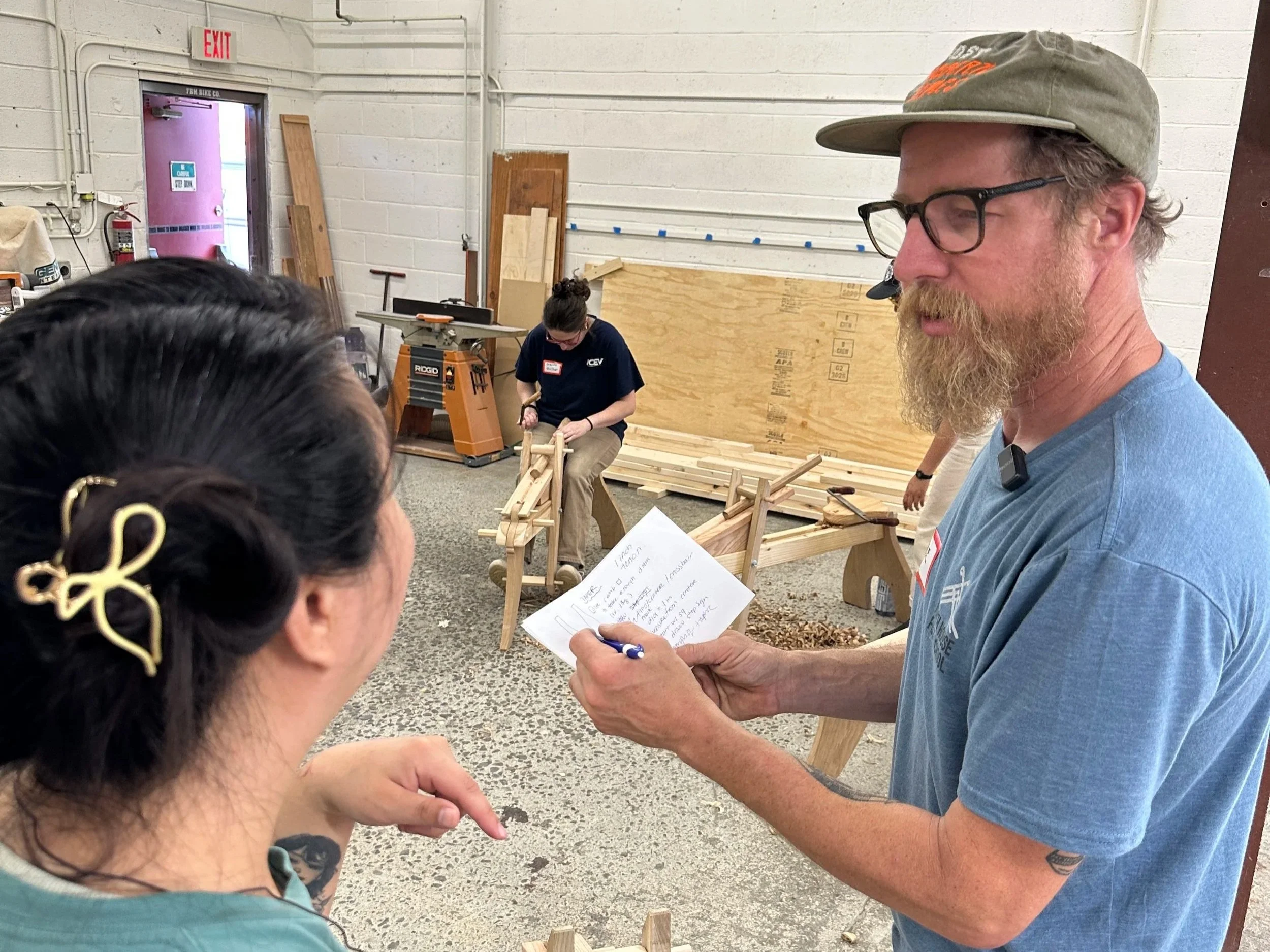
Gabe Strand and student chatting during class.
For many, woodworking is almost synonymous with power tools. Routers, table saws, planers, and sanders have become the default image of a modern shop. Our recent class, Intro to Staked Furniture: Build a Hearth Stool with guest instructor Gabe Strand of Green Cove Craft, we challenged that assumption. Over two days, we slowed down and built beautiful three-legged hearth stools using mostly hand tools—a drawknife, spokeshave, block plane, and a few carefully chosen machines only where they truly made sense. The band saw helped us rough out our seat blanks, but nearly every visible surface that your hands touch was shaped by hand. We spent hours at shave horses turning square stock into graceful, octagonal tapered legs, paying close attention to grain direction, tool angle, and the subtle feedback that only hand tools provide. Each shaving that curled away from the workpiece was feedback about what the wood wanted us to do next. By the end of the weekend, every stool reflected not just its maker, but the hundreds of thoughtful decisions that went into shaping it. It was a reminder that furniture can be made with remarkably few tools when you understand the material and trust the process.
Sharp hand tools have a way of connecting you to the work. A drawknife quickly reveals how wood fibers want to split. A spokeshave rewards tiny adjustments in body position and pressure. A block plane leaves behind a finished surface that often needs no sanding at all. These "old-fashioned" skills are also nowadays practical skills. They make you a better woodworker regardless of what kind of shop you have. If you've ever wanted to soften an edge after assembly, tune a joint that's just a hair too tight, shape a replacement part without setting up a machine, or work quietly without filling the shop with dust, these are the tools you'll reach for. Learning when to put down the power tool and pick up a hand tool isn't about rejecting modern woodworking. It's about adding another set of solutions to your toolbox. That flexibility makes every future project a little easier and a lot more enjoyable.
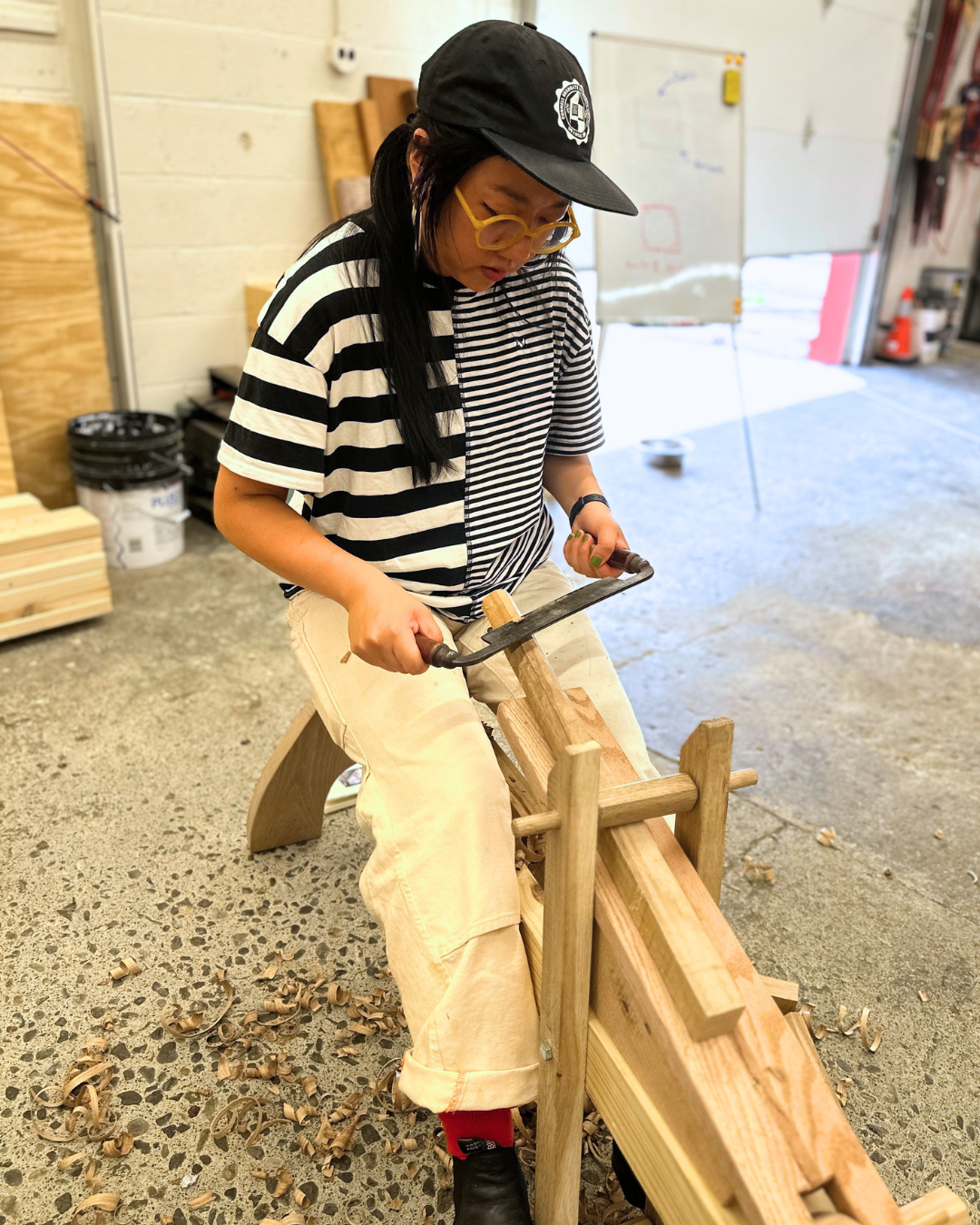
Student uses a drawknife and shave horse to shape their stool legs.
The stool itself introduced us to one of the oldest and most enduring furniture-building methods: staked, or wedged, joinery. Rather than relying on complicated hardware or elaborate joinery, each leg passes through the seat and is secured with a wedged tenon, creating a mechanical joint that actually tightens over time. It's a technique that has been used for centuries in everything from humble milking stools to Windsor chairs because it's simple, elegant, and incredibly strong. Watching those joints come together was one of the most satisfying moments of the weekend. A project that began as rough square blanks gradually transformed into something refined, sculptural, and built to last a lifetime. There is something deeply satisfying about building furniture that relies more on thoughtful design than on hardware or adhesives.
My favorite takeaway from the weekend wasn't necessarily a particular technique, but rather a different pace of working. Hand tools encourage you to slow down, be more mindful and in the moment, and think only a step or two ahead instead of racing toward the finish line. You notice grain before making a cut. You feel the wood grab and rethink your course. You pay attention to body position, tense muscles and all. You feel when your tools start to dull and sharpen them because it, too, is part of the process. Those habits don't stay in a hand-tool class—they carry into every future project. Building cabinets with sheet goods or framing a wall with dimensional lumber? Taking an extra breath here and there throughout those generally fast prep processes is a practice worth incorporating.
We're so excited to continue bringing instructors like Gabe to Hammerstone. They remind us that learning woodworking isn't just about accumulating tools or techniques. It's about developing judgment, confidence, and an appreciation for the craft that makes every project, big or small, a little more intentional. And judging by the smiles around the shop at the end of the weekend, I'd say every one of us left with far more than just a beautiful new hearth stool.
Plane and simple,
Christina
